🧠 docs-pipe — Turn Your Docs Into a Searchable, Question-Answering AI
A documentation-native RAG module and a web dashboard — heading-aware chunking, hybrid search, cited answers, and a one-command UI. All in pure Pipe.
Related: RAG in ~10 lines · Your first MCP server
Your docs/ folder is the most underused asset in the repo. It has the answers — but nobody *searches* it, because classic RAG means standing up a stack: a vector database, an embedding SDK, a chunking library, and glue code to wire it together. Then you maintain all of it.
docs-pipe collapses that into one module (pure Pipe, zero native dependencies) and one example that turns it into a dashboard.
The module: six functions
Install it like any Pipe module:
pipe -get docs-pipeThen index a Markdown tree, search it by *meaning + keywords*, and ask questions with cited answers:
ai_provider "deepseek"
import "docs-pipe"

idx: doc_index "docs/en" {lang: "en", db: "pipe_docs.db"}
print (to_str (doc_index_status idx))     -- {files: 28, chunks: 317, lang: en}

-- Hybrid retrieval: keywords + semantics, fused
for r in (doc_search idx "How does the bytecode VM work?" 3)
    print ((get r "path") ++ ":" ++ (to_str (get r "line_start")) ++ " — " ++ (get r "heading"))

-- Grounded answer, with sources
res: doc_ask idx "What is MCP?" 3
print (get res "answer")                  -- answers and cites [1], [2], [3]

doc_close idx                              -- persist to pipe_docs.db
The full API is six functions: doc_index, doc_index_status, doc_search, doc_ask, doc_reindex, doc_close.
What it does that a naive "embed everything" script doesn't:
- Heading-aware chunking. Documents are split on
#/##/###boundaries, fenced code blocks stay intact, and every chunk remembers its file, line range, and heading path (Bytecode VM > Components > Compiler). Indexingdocs/enyields 28 files → 317 chunks. - Hybrid search. A TF-IDF keyword score and a cosine-similarity score are fused — and the weights adapt automatically: local 128-dim embeddings lean on keywords, OpenAI's 1536-dim embeddings lean on semantics. Identifiers stay single tokens (
try_ai, nottry+ai), and a query term matching a chunk's *heading* is boosted — so "try_ai" surfaces thetry_ai — AI Self-Healingsection, not just any passing mention. - Detailed, cited answers.
doc_askreturns a thorough, step-by-step answer with code examples when the context shows them — *and* the sources (path:line — heading), so you can always trace a claim back to the doc. - Incremental re-indexing. Each file is hashed with SHA-256;
doc_reindexre-chunks and re-embeds only what changed. - Works offline. DeepSeek has no embedding API, so
embedfalls back to a built-in local embedding — indexing and search run with no API key. Onlydoc_askneeds one, and a full answer costs a fraction of a cent (well under $0.001).
The dashboard: docs-pipe with a face
docs-pipe is the engine; examples/docs_pipe_dashboard.pipe is the product. One command:
make docs-dashboardIt builds, indexes docs/en, serves on :8090, and opens your browser. What you get:
- Live search — type and results appear, debounced, with matched terms highlighted and every hit linking to a source viewer that scrolls to the exact line.
- Filters — by file and language (
en/de), with a result count and millisecond latency. - Ask — a cited answer — rendered as Markdown (headings, code blocks) — with the sources below it, each one clickable.
- Stats — files, chunks, vector dimension, AI call count, and cost, plus a log of your recent queries.
- A real menu — sticky nav, burger menu on mobile, progress bar on every request, copy-to-clipboard buttons.
What it looks like:
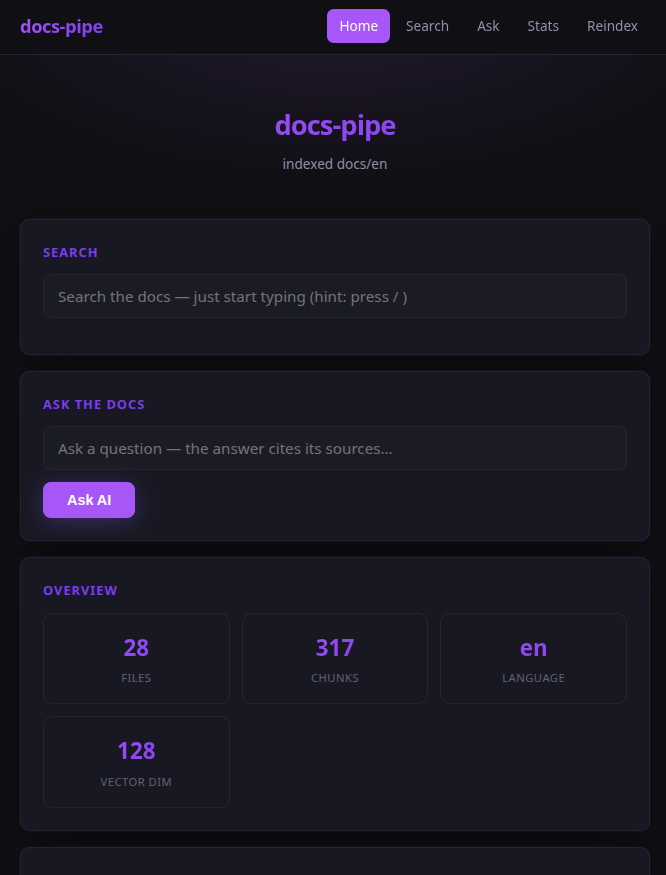
*The landing page: live search, the ask box, and index stats.*
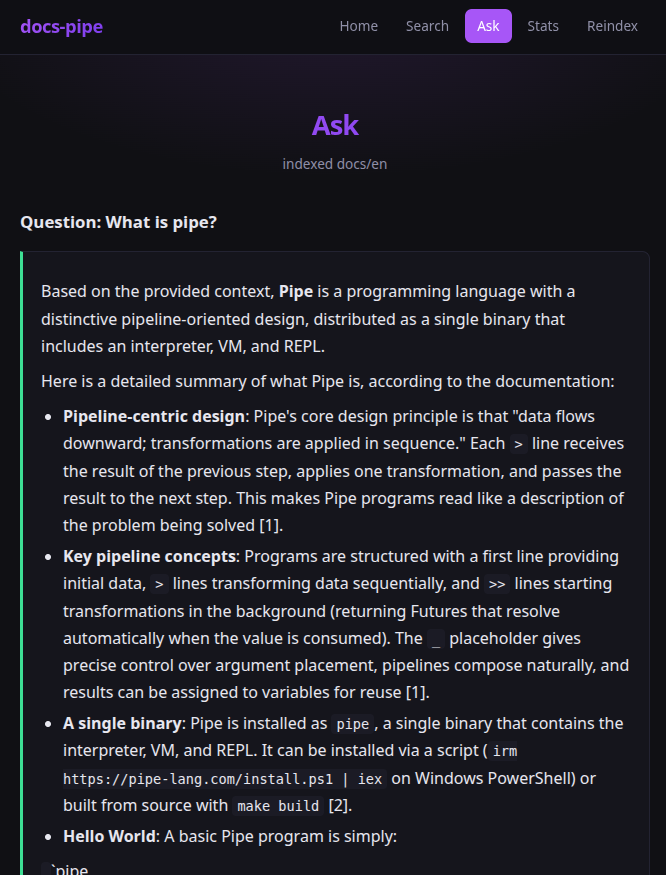
*The ask page — a cited answer with its sources below it.*
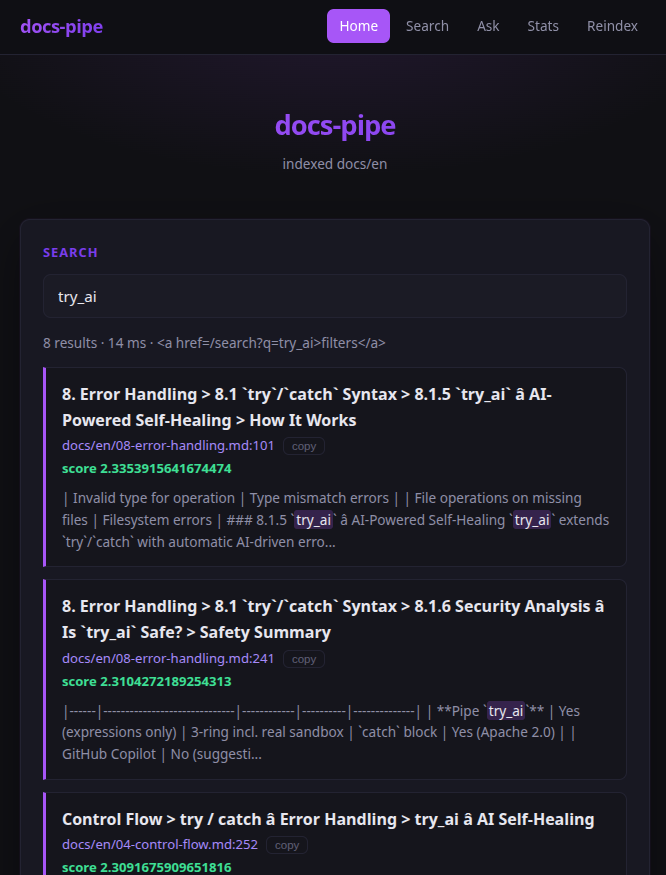
*Search as you type — results appear debounced, with matched terms highlighted.*
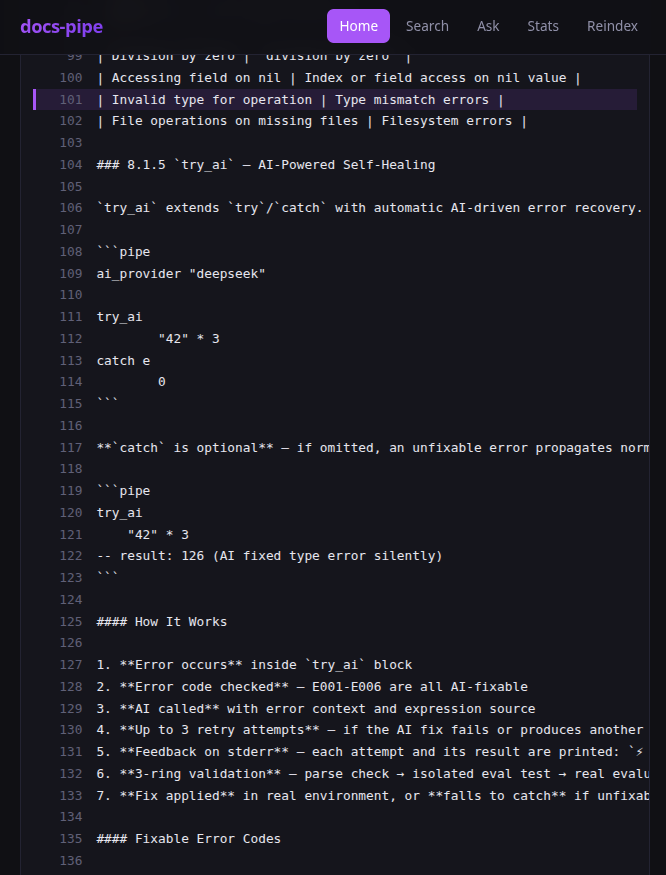
*Click any result to open the source file, scrolled to the exact line.*
The same file doubles as an MCP server. Run it with PIPE_MODE=mcp and it exposes three tools — search_docs, ask_docs, read_doc — so Claude Desktop, Cursor, or any MCP client can query your documentation directly, in the editor.
PIPE_MODE=mcp DEEPSEEK_API_KEY=... ./bin/pipe examples/docs_pipe_dashboard.pipeHonest limits
- Local embeddings are weaker than OpenAI's. Semantic recall is *fine* for a docs folder, but if you want best-in-class retrieval, set
ai_provider "openai". - Search is brute-force over the in-memory index. It's a few milliseconds for a few hundred chunks and stays snappy into the low thousands — it is *not* a FAISS replacement for a hundred thousand documents.
- The dashboard is a demo, not a multi-tenant service: one process, one index, one query at a time.
Try it
- Module:
pipe-modules/docs-pipe— 424 lines of pure Pipe. - Example:
examples/docs_pipe_dashboard.pipe.
git clone https://github.com/MachuraHarry/pipe
cd pipe && make docs-dashboard                            # opens http://localhost:8090
🧠 docs-pipe — Verwandle deine Doku in eine durchsuchbare, Frage-beantwortende KI
Ein dokumentations-natives RAG-Modul und ein Web-Dashboard — heading-bewusstes Chunking, hybride Suche, zitierte Antworten und ein Ein-Befehl-UI. Alles in reinem Pipe.
Verwandt: RAG in ~10 Zeilen · Dein erster MCP-Server
Dein docs/-Ordner ist der am meisten unterschätzte Schatz im Repo. Er hat die Antworten — aber niemand *sucht* darin, weil klassisches RAG einen ganzen Stack bedeutet: eine Vektor-DB, ein Embedding-SDK, eine Chunking-Bibliothek und Kleber-Code. Und dann pflegst du das alles.
docs-pipe reduziert das auf ein Modul (reines Pipe, null native Abhängigkeiten) und ein Beispiel, das daraus ein Dashboard macht.
Das Modul: sechs Funktionen
Installieren wie jedes Pipe-Modul:
pipe -get docs-pipeDann einen Markdown-Baum indexieren, nach *Bedeutung + Keywords* durchsuchen und Fragen mit zitierten Antworten stellen:
ai_provider "deepseek"
import "docs-pipe"

idx: doc_index "docs/en" {lang: "en", db: "pipe_docs.db"}
print (to_str (doc_index_status idx))     -- {files: 28, chunks: 317, lang: en}

-- Hybride Suche: Keywords + Semantik, fusioniert
for r in (doc_search idx "Wie funktioniert die Bytecode-VM?" 3)
    print ((get r "path") ++ ":" ++ (to_str (get r "line_start")) ++ " — " ++ (get r "heading"))

-- Fundierte Antwort, mit Quellen
res: doc_ask idx "Was ist MCP?" 3
print (get res "answer")                  -- antwortet und zitiert [1], [2], [3]

doc_close idx                              -- in pipe_docs.db persistieren
Die komplette API besteht aus sechs Funktionen: doc_index, doc_index_status, doc_search, doc_ask, doc_reindex, doc_close.
Was es besser macht als ein naives „alles einbetten"-Skript:
- Heading-bewusstes Chunking. Dokumente werden an
#/##/###-Grenzen geteilt, umschlossene Code-Blöcke bleiben intakt, und jeder Chunk merkt sich Datei, Zeilenbereich und Überschriftenpfad (Bytecode VM > Komponenten > Compiler).docs/energibt 28 Dateien → 317 Chunks. - Hybride Suche. Ein TF-IDF-Keyword-Score und ein Kosinus-Ähnlichkeits-Score werden fusioniert — und die Gewichtung passt sich automatisch an: lokale 128-dim-Embeddings setzen auf Keywords, OpenAIs 1536-dim-Embeddings auf Semantik. Bezeichner bleiben einzelne Tokens (
try_ai, nichttry+ai), und ein Suchbegriff, der die *Überschrift* eines Chunks trifft, wird geboostet — so findet „try_ai" den Abschnitttry_ai — AI Self-Healing, nicht nur jede beiläufige Erwähnung. - Detaillierte, zitierte Antworten.
doc_askliefert eine gründliche Schritt-für-Schritt-Antwort mit Code-Beispielen, wenn der Kontext sie zeigt — *und* die Quellen (path:line — heading), damit jede Behauptung nachvollziehbar ist. - Inkrementelles Indexieren. Jede Datei wird per SHA-256 gehasht;
doc_reindexzerlegt und bettet nur Geändertes neu ein. - Läuft offline. DeepSeek hat keine Embedding-API, daher fällt
embedauf ein eingebautes lokales Embedding zurück — Indexieren und Suchen laufen ohne API-Key. Nurdoc_askbraucht einen, und eine volle Antwort kostet einen Bruchteil eines Cents (deutlich unter $0,001).
Das Dashboard: docs-pipe mit Gesicht
docs-pipe ist der Motor; examples/docs_pipe_dashboard.pipe ist das Produkt. Ein Befehl:
make docs-dashboardEr baut, indexiert docs/en, startet auf :8090 und öffnet den Browser. Was du bekommst:
- Live-Suche — tippen und Ergebnisse erscheinen (debounced), Trefferbegriffe markiert, jeder Treffer verlinkt auf einen Quelltext-Viewer, der zur exakten Zeile scrollt.
- Filter — nach Datei und Sprache (
en/de), mit Trefferzahl und Latenz in Millisekunden. - Ask — eine zitierte Antwort — als Markdown gerendert (Überschriften, Code-Blöcke) — mit den Quellen darunter, jede klickbar.
- Stats — Dateien, Chunks, Vektor-Dimension, KI-Aufrufe und Kosten, plus ein Log deiner letzten Suchen.
- Ein echtes Menü — Sticky-Navigation, Burger-Menü auf Mobile, Fortschrittsbalken bei jeder Anfrage, Copy-to-Clipboard-Buttons.
So sieht es aus:
*Die Startseite: Live-Suche, Ask-Box und Index-Statistik.*
*Die Ask-Seite — eine zitierte Antwort mit den Quellen darunter.*
*Suche beim Tippen — Ergebnisse erscheinen debounced, Trefferbegriffe markiert.*
*Klick auf ein Ergebnis öffnet die Quelldatei, gescrollt zur exakten Zeile.*
Dieselbe Datei ist zugleich ein MCP-Server. Mit PIPE_MODE=mcp stellt sie drei Tools bereit — search_docs, ask_docs, read_doc — sodass Claude Desktop, Cursor oder jeder MCP-Client deine Dokumentation direkt im Editor befragen kann.
PIPE_MODE=mcp DEEPSEEK_API_KEY=... ./bin/pipe examples/docs_pipe_dashboard.pipeEhrliche Grenzen
- Lokale Embeddings sind schwächer als die von OpenAI. Semantisches Retrieval ist *in Ordnung* für einen Doku-Ordner, aber für beste Qualität setze
ai_provider "openai". - Die Suche ist Brute-Force über den In-Memory-Index. Das sind wenige Millisekunden bei ein paar hundert Chunks und bleibt bis in den niedrigen Tausenderbereich flott — ein FAISS-Ersatz für hunderttausend Dokumente ist es *nicht*.
- Das Dashboard ist eine Demo, kein Multi-Tenant-Service: ein Prozess, ein Index, eine Anfrage gleichzeitig.
Ausprobieren
- Modul:
pipe-modules/docs-pipe— 424 Zeilen reines Pipe. - Beispiel:
examples/docs_pipe_dashboard.pipe.
git clone https://github.com/MachuraHarry/pipe
cd pipe && make docs-dashboard                            # öffnet http://localhost:8090